Introduction
You type a message. You press send. A few seconds later, text appears on your screen.
That gap - between your input and the AI's response - often feels like a black box. You see what goes in and what comes out, but not what happens in between. That's the gap this article is designed to close.
Understanding what actually happens when you send a prompt does more than satisfy curiosity. It gives you a practical foundation for writing better prompts. When you know how an AI model reads your input, processes it, and generates a response, you can make more deliberate choices about how you write - and set more accurate expectations for what you'll get back.
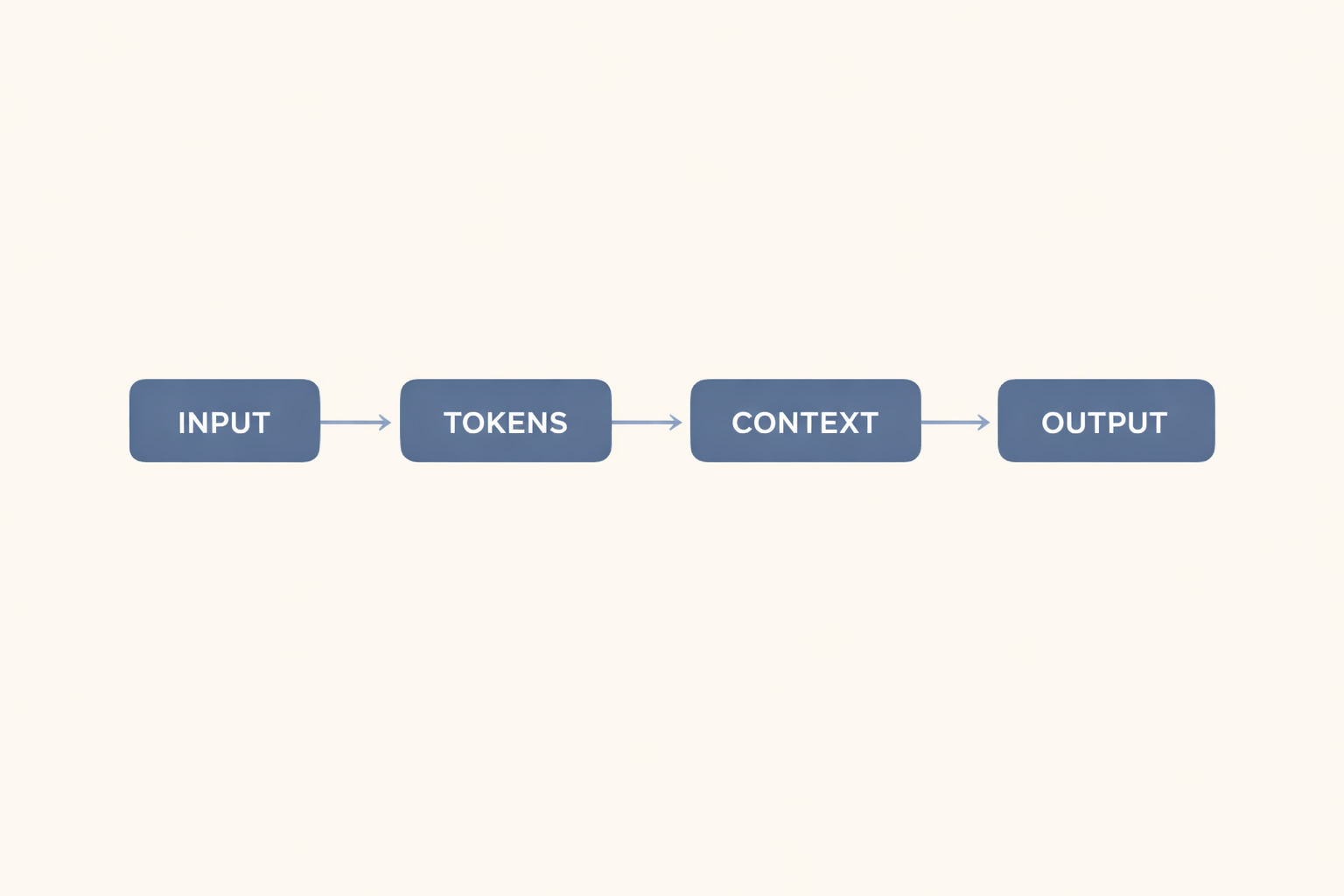
This article walks through the full journey: from the moment you send a prompt to the moment a response arrives. It covers tokenization, the context window, output generation, and the key factors shaping each step.
Why This Matters for Prompt Writing
Many people treat AI models the way they treat search engines: type something in, get something back, and adjust from there. That approach can work for simple requests. But it tends to break down when tasks get more complex - when you need a specific format, a particular tone, or a response that accounts for detailed context.
When results don't match expectations, the instinct is often to change something - try a different wording, add more detail, or reframe the question. Those adjustments can help, but without knowing what the model is actually doing with your input, you're making changes without a clear reason.
Knowing the mechanics gives you leverage. It helps you understand why a vague prompt tends to produce a vague response, why long prompts don't automatically produce better outputs, and why the same prompt can behave differently across different tools. That knowledge is what turns prompt writing from guesswork into deliberate practice.
Step 1 - Tokenization: How the Model Reads Your Input
Before an AI model can process anything you've written, it needs to convert your text into a form it can work with. That process is called tokenization.
Tokenization breaks your input into smaller units called tokens. Tokens are not the same as words. A token may be a whole word, part of a word, or a punctuation character. A short sentence might produce six tokens. A long paragraph might produce sixty or more. The exact breakdown depends on the model's tokenizer - the internal system it uses to split text.
Here's a simplified example. A sentence like "Please summarize this article clearly" might be split into tokens along these lines:
| Original Text | Token Breakdown (approximate) |
|---|---|
| "Please summarize this article clearly." | [Please] [sum] [mar] [ize] [this] [article] [clearly] |
| "AI" | [AI] - single token |
| "Tokenization" | [Token] [ization] - two tokens |
What this means in practice: the model does not read your prompt the way a person reads a sentence. It processes a sequence of tokens, each weighted by patterns it learned during training. The meaning it derives is constructed from those patterns - not from grasping your intent directly.
This has direct implications for how you write. Word choice, sentence structure, and phrasing all affect how tokens are arranged - and that arrangement influences the output. Subtle differences in wording can activate different patterns and shift the response in ways that are not always obvious. Precise language tends to produce more predictable results; ambiguous phrasing often produces broader, less targeted responses.
Key principle: An AI model processes the words and structure you provide - not the intent behind them. Writing clearly and specifically gives the model more to work with.
Step 2 - The Context Window: Your Working Space
Once your prompt is tokenized, it enters the model's context window. The context window is the maximum amount of text - measured in tokens - that the model can work with in a single interaction. It includes everything: your prompt, any prior conversation in the session, and the model's response as it's generated.
Think of the context window as a workspace with a fixed size. Everything that needs to inform the response must fit within that space. If your input is long - a pasted document, a multi-step conversation, or a detailed set of instructions - the total must fit within the available limit.
When an input pushes against the context limit, the model can only work with what fits. In practice, this tends to mean that earlier content in a long input receives less weight than content near the end - because the model prioritizes what's most recent in its working memory. A long pasted document, for example, may produce a summary that draws more from the final sections than the first.
This is not a failure of the prompt - it's a structural constraint. Understanding it helps you plan. For large documents, breaking the task into smaller sections often produces more consistent results than pasting everything at once.
Context Windows and Base AI Models
It's important to note that context limits apply to each session, and base AI models - text-only systems with no tools and no external memory - start each session fresh. The model has no memory of previous conversations. It can only work with what you include in the current interaction.
Tool-connected AI systems may manage context differently. Some platforms use memory features or integrations that allow information to persist across sessions. But that is a platform-level capability, not something the base model provides on its own. When working with a base model, treat each session as a clean slate.
Context window size varies by model and version. What's consistent is the principle: everything the model needs to produce a useful response should be present in the current prompt.
Step 3 - Model Processing: Pattern Matching at Scale
Once the context window is populated, the model processes the tokens according to the patterns it learned during training. This is the core of what large language models do.
A language model is trained on vast amounts of text. Through that training, it learns statistical patterns: which tokens tend to follow which other tokens, across a huge range of contexts. When you send a prompt, the model uses those learned patterns to determine the most likely sequence of tokens for a response given your input.
It's worth being precise about what this is and what it isn't. The model does not reason the way a person reasons. It is not looking up facts, checking sources in real time, or applying judgment. It is generating text based on learned patterns - which means the quality and accuracy of its output depend heavily on the patterns in its training data.
What This Means for Your Prompts
Because the model works by pattern matching, prompts that are clear, specific, and well-structured tend to activate more relevant patterns. A prompt that says "Write a 3-sentence summary of the following text in plain language" gives the model a defined task, length, format, and audience register. That specificity narrows the pattern space, which typically makes the output more aligned with what you actually need.
A prompt that says "Summarize this" leaves nearly all of those variables open. The model will still produce something, but the output could match any number of plausible interpretations.
Step 4 - Output Generation: One Token at a Time
The model doesn't produce a complete response all at once. It generates the output one token at a time, with each token selected based on what the model calculates as the most likely next token given everything that came before it - including your prompt and all the tokens it has already generated.
This sequential generation is why longer responses can sometimes drift. A response that starts on track may shift as the generated tokens accumulate - because each new token is influenced by what's already been produced, not just by your original prompt.
It also explains why prompts that include a clear structure or format instruction tend to perform more reliably on longer outputs. When the model has a defined shape to follow - a specific number of sections, a defined list format, or a required length - the structure acts as a continuous constraint throughout the generation process.
The output is not retrieved or looked up - it is generated, token by token, based on patterns. This is why prompt structure affects output quality throughout a response, not just at the start.
Practical Application: Using the Process to Improve Your Prompts
Understanding the four steps - tokenization, context window, model processing, and output generation - gives you a framework for diagnosing why a prompt isn't working and what to adjust.
If the Output Feels Too Broad or Unfocused
This often indicates that the prompt left too many variables open. The model had a wide pattern space to draw from and selected something plausible rather than something targeted. Try adding specificity: define the format, length, audience, or tone.
If the Output Misses Something Important from a Long Input
This may reflect a context window constraint. If you pasted a long document, the model may have weighted later sections more heavily. Try breaking the task into smaller pieces and processing them separately, or place your most important content closer to the instructions.
If the Output Drifts or Loses Focus Partway Through
This can happen on longer responses when the prompt doesn't define a structure. Adding a formatting instruction - numbered sections, a defined list format, or a specific word count - helps maintain consistency throughout the output.
If the Output Doesn't Match Your Intent
The model processed what you wrote, not what you meant. Review the prompt for ambiguity: is there more than one reasonable interpretation? The part of your prompt that is open to interpretation is often the part responsible for the gap. Rewrite it more precisely and test again.
Key Takeaways
- Tokenization breaks your prompt into small units called tokens. The model works with those tokens - not with words or sentences as a whole. Word choice and structure affect how tokens are interpreted.
- The context window sets a limit on how much text the model can process in one interaction. Everything that needs to inform the response - your prompt, any prior conversation, and the model's output - must fit within that limit.
- Model processing works through pattern matching. The model generates output based on patterns learned during training, not through reasoning or real-time fact retrieval.
- Output is generated one token at a time. Each token is selected based on what the model calculates as most likely given everything before it - which is why structure and format instructions help maintain consistency in longer responses.
- Base AI models start each session fresh. They have no memory of previous conversations and no access to external data. They can only work with what you include in the current prompt.
- Prompt clarity directly affects output quality. The more precisely you define the task, format, length, and audience, the more you narrow the range of likely outputs - and the more likely the result will align with what you actually need.




0 Comments