
Introduction
You write a prompt. You send it. The response comes back - but something is off. The information is outdated. The answer cuts off before it covers the full topic. Or you ask about something that happened last week, and the model seems to have no idea what you mean.
These are not random failures. They are predictable outcomes. They trace back to three specific constraints built into every AI model. Understanding these constraints will not make them disappear. But it will help you write prompts that work with them - and set expectations that match how the system actually behaves.
This article covers the three AI model constraints every prompt writer should know: context limits, training data boundaries, and the absence of real-time data access in base models. Each constraint is explained, illustrated with examples, and connected to practical implications for how you prompt.
Why AI Model Constraints Matter for Prompt Writing
When a prompt does not produce a useful result, the instinct is often to blame the wording. Sometimes that is the right diagnosis. But in many cases, the issue is not how the prompt was written - it is what the model structurally cannot do.
AI model constraints are not bugs or failures. They are design realities. A base AI model - a text-only system with no tools, no memory, and no external data connections - operates within fixed limits. Knowing those limits helps you avoid prompts that ask the model to do something it cannot do. It also helps you recognize when a task calls for a different kind of system, such as a tool-connected AI platform.
The distinction between base AI models and tool-connected AI systems (introduced in Chapter 2) is important here. A base model works entirely from its training data and whatever you include in the current prompt. A tool-connected system may extend these capabilities through platform features such as memory, code execution, or file access. This article focuses on base model constraints - the boundaries that apply regardless of which tool you are using.
Constraint 1: Context Limits
What it is
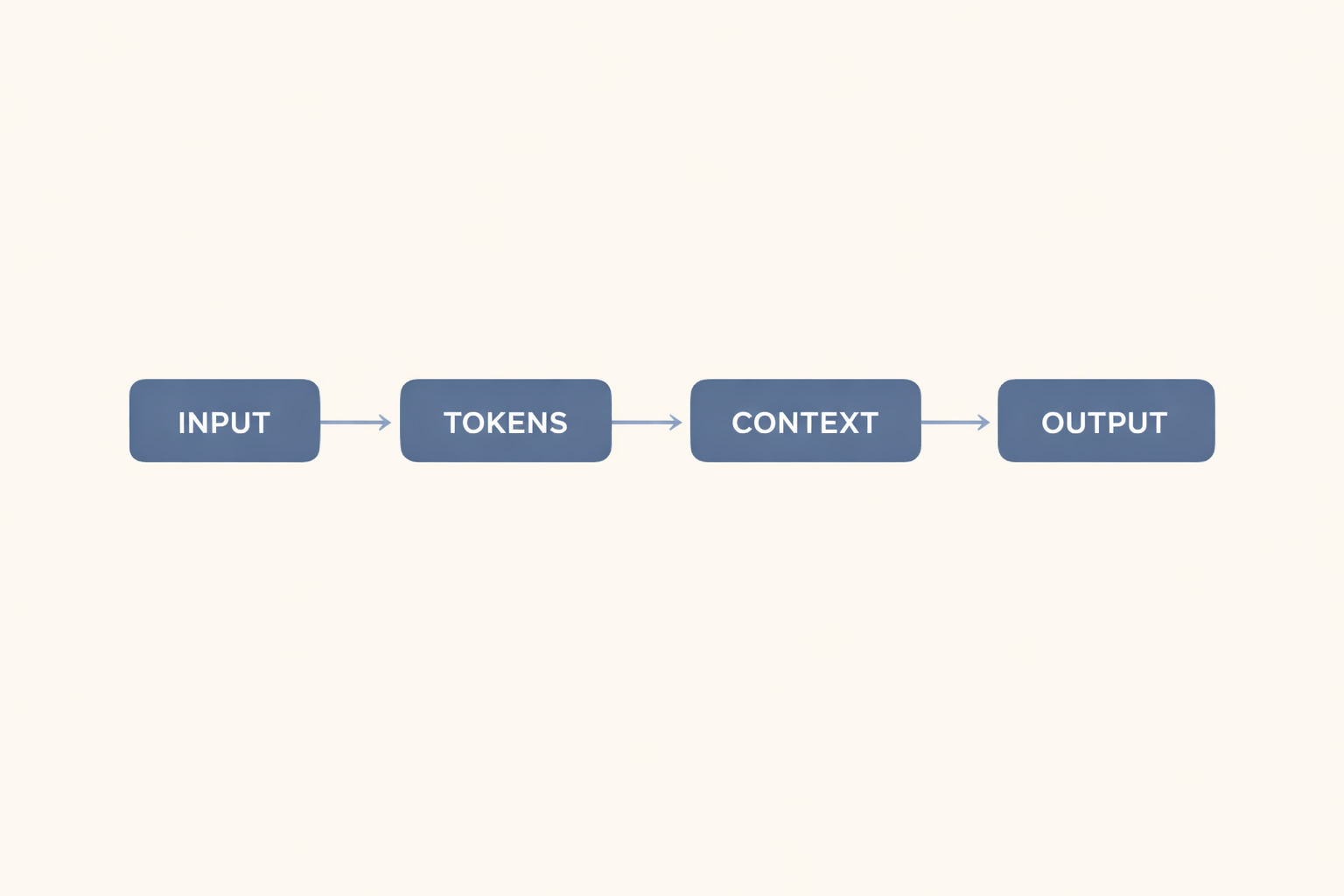
Every AI model can only process a finite amount of text in a single interaction. This limit is defined by the context window - the maximum number of tokens (the small units of text the model works with) that the model can process at once. The context window includes both what you send in and what the model generates in response.
Context windows vary by model and platform. Some are relatively small. Others can handle very long inputs. But all of them have a ceiling.
What it means for your prompts
When your input is short - a question, a brief task, a few lines of background - context limits typically are not a concern. The issue arises with larger inputs: long documents, extended conversations, and detailed reference material.
If your input pushes against the context limit, the model typically processes only what fits. In practice, this often means earlier sections of a long input receive less attention than sections closer to the end. The result may feel incomplete - not because the prompt was poorly written, but because the constraint was structural.
How to work with this constraint
- Break long documents into segments. Send each segment as a separate prompt.
- Prioritize the most important content. Place critical instructions or information near the end of your prompt, where models tend to weigh context more heavily.
- Keep multi-step conversations focused. In a base model, context does not carry over between sessions. Start each new session with the context needed for that task.
- Check the context limits for the specific model or platform you are using. These limits vary, and knowing the ceiling for your tool helps you plan prompts accordingly.
Constraint 2: Training Data Boundaries
What it is
An AI model generates outputs based on patterns in the data it was trained on. That training has a cutoff - a point in time beyond which the model has no knowledge. Information published, events that occurred, or legislation passed after that cutoff date is simply not part of what the model learned.
This boundary is called the training cutoff. It is fixed at the time the model was trained. The model cannot update itself between training sessions.
What it means for your prompts
For many tasks, the training cutoff is not a practical concern. You can ask the model to draft a report, summarize a concept, or help structure an argument without needing current data. These tasks draw on language patterns and general knowledge - areas where the training data remains relevant regardless of when it was collected.
The constraint becomes significant when your task requires up-to-date information. If you ask a base AI model about recent events, newly passed regulations, or data published after its training cutoff, it will not have that information. It may still produce a response - but that response will be based on patterns from its training data, not current facts. The output may be outdated, incomplete, or confidently wrong in ways that are not immediately obvious.
How to work with this constraint
- Identify whether your task requires current information. If it does, a base AI model is typically not the right tool on its own.
- Provide the current information yourself. If you have access to current data, include it in your prompt. A well-structured base model can often analyze, summarize, or apply current data that you supply directly.
- Acknowledge the cutoff in your prompt when relevant. Framing your request around a specific time period - for example, "based on publicly available information from 2023" - can help set accurate expectations for both you and the model.
- Use a tool-connected AI platform when current data access is required. Some platforms connect AI models to live search, databases, or APIs. These capabilities come from the platform design - not the base model itself.
Constraint 3: No Real-Time Data Access in Base Models
What it is
A base AI model cannot browse the web, retrieve a live document, check a current database, or pull data from any external source in real time. When you prompt a base model, it operates entirely on two inputs: what you include in your prompt and what it learned during training.
This is not a limitation of any specific model version. It is a fundamental characteristic of base model design. They are closed systems - they process text and generate text, entirely from the materials they have been given.
The distinction from tool-connected systems
Some AI platforms extend the base model's capabilities through tools - web search, code execution, file access, memory, and API integrations. When these tools are active, the system can retrieve real-time data, run calculations, or reference external files.
These capabilities come from the platform's design, not the base model itself. If you are using a tool-connected AI platform, check which tools are actually active in your session. Do not assume that all tool-connected features are available just because the platform offers them.
How to work with this constraint
- Supply the data in your prompt when possible. If you have a current report, a recent document, or a live data export, paste the relevant portion into your prompt. A base model can often work effectively with the current data you provide directly.
- Reserve real-time data tasks for tool-connected systems. Tasks like checking live stock prices, pulling current news, or querying a live database require a platform that connects the model to external data sources.
- Set accurate expectations before you prompt. If you know a task requires live data and you are working with a base model, either adjust the task to work with supplied data or use a different tool.
Applying These Constraints in Practice
These three constraints often appear in combination. A task that involves a long document, current information, and real-time data hits all three at once. Recognizing the pattern early helps you make better decisions about how to structure your prompt and which tool to use.
Here is a quick reference for the three constraints and their practical implications:
| Constraint | What the model cannot do | Practical workaround |
|---|---|---|
| Context limits | Process more text than its context window allows in a single interaction | Break long inputs into segments; send each as a separate focused prompt |
| Training data boundaries | Access knowledge about events or data published after its training cutoff | Supply current information in your prompt, or use a tool-connected platform with live data access |
| No real-time data access | Browse the web, query a live database, or retrieve a current document during the session | Paste relevant data directly into the prompt, or use a tool-connected system that supports real-time data |
Key Takeaways
- Every AI model has a context window - a limit on how much text it can process in a single interaction. Long inputs may exceed this limit, resulting in incomplete or uneven outputs.
- Base AI models have a training cutoff. They are unaware of any events, data, or publications that postdate their training. Responses to recent topics will reflect training-era knowledge rather than current facts.
- A base AI model cannot access external data in real time. It cannot browse the web, query a database, or retrieve a document during a session. It works only with its training data and what you provide in your prompt.
- These constraints are structural, not fixable through better phrasing alone. Recognizing which constraint applies to a given task helps you decide how to structure your prompt and whether a tool-connected system is needed.
- Tool-connected AI platforms can extend these capabilities - but those capabilities come from platform design, not the base model itself. Always confirm which tools are active in your session.
- The most effective response to AI model constraints is to work with them: segment long inputs, supply current data directly, and match the tool to the task.
What to Do Next
These three constraints give you a more accurate picture of what base AI models can and cannot do. That accuracy is the foundation of effective prompting. When you know the limits, you can design prompts that stay within them.
Before you move on, try this: review a recent prompt that produced an incomplete or unexpected result. Ask yourself whether context limits, training data boundaries, or the absence of real-time data could have been a factor. If any of those apply, consider how you would adjust the prompt or the approach.
The next step is understanding how these constraints shape your prompt design choices - which is covered in Chapter 3: Understanding the Building Blocks of Prompts.



0 Comments